
Organization Without Perfection
I Asked ChatGPT to Organize My Junk Drawer — Without Buying Anything
I was very close to buying another drawer organizer.
You know the kind of drawer I mean.
Pens. Scissors. Clips. Hand cream. A tape measure. Random cables. A lighter. A sponge. And somehow, even though everything technically had a place inside the drawer, nothing was actually easy to find.
It looked exactly like the kind of problem that needed one more storage product.
So before buying anything, I tried something else.
I pulled out a few containers I already had at home and asked ChatGPT to help me make the drawer easier to use — without turning it into a tiny Pinterest project.
And surprisingly, the most useful part of the answer was how little organizing it suggested.
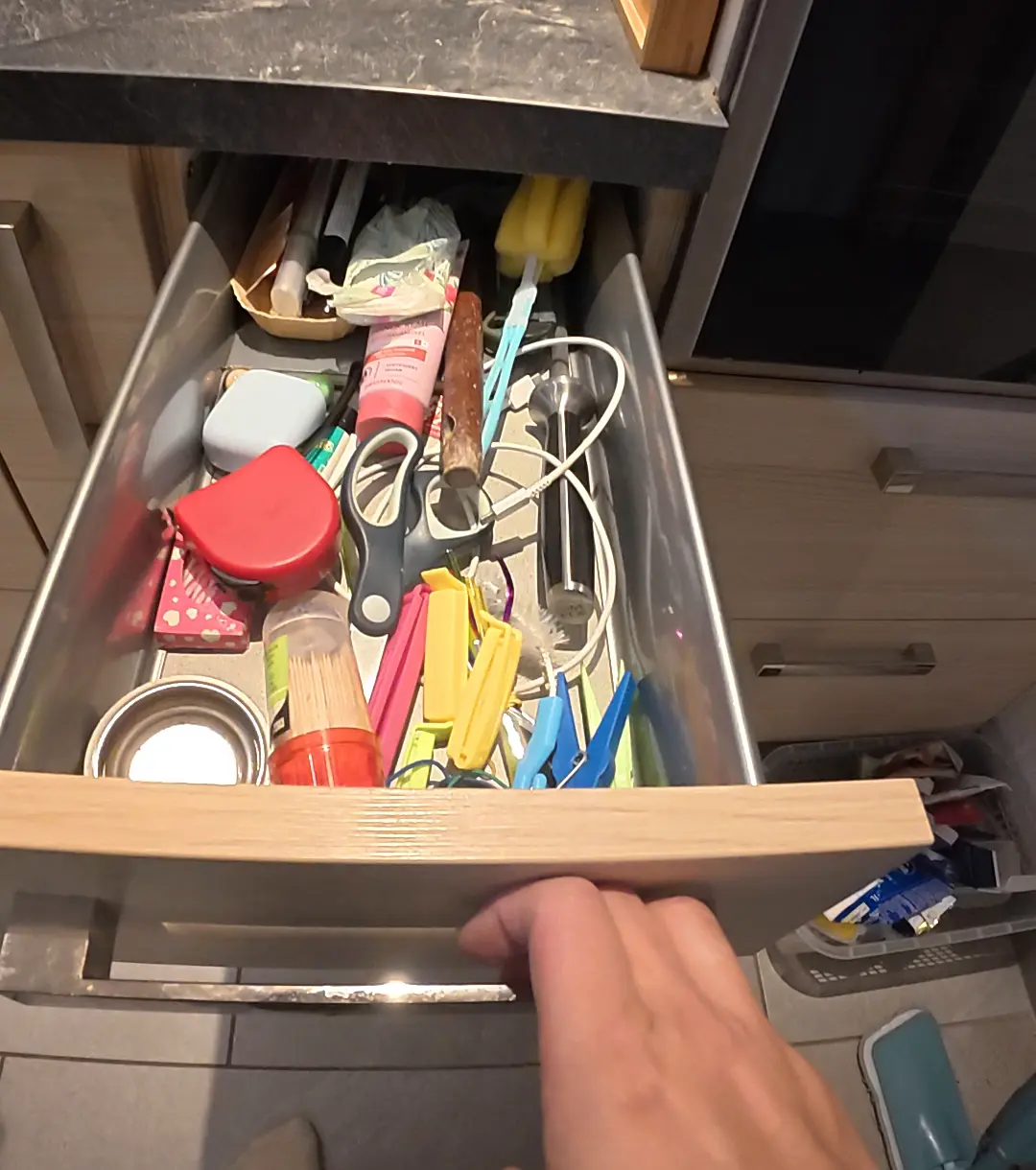
The real problem wasn’t a lack of organizers
The drawer wasn’t staged for the experiment.
It had simply become a classic catch-all zone: useful everyday things slowly mixed together until finding one pair of scissors meant rummaging through everything else.
My first instinct was pretty predictable:
Maybe I just need a proper drawer insert.
But before adding another thing to the house, I wanted to check whether the actual problem was the container — or the system.
So I looked around for things we already owned.
I found a few possible options, including a small shallow box, a plastic basket, a cardboard tray, an existing pen holder and a couple of other small containers.
Some looked useful.
Some looked like the beginning of a very complicated organizing system I would absolutely stop maintaining three days later.
That distinction mattered.
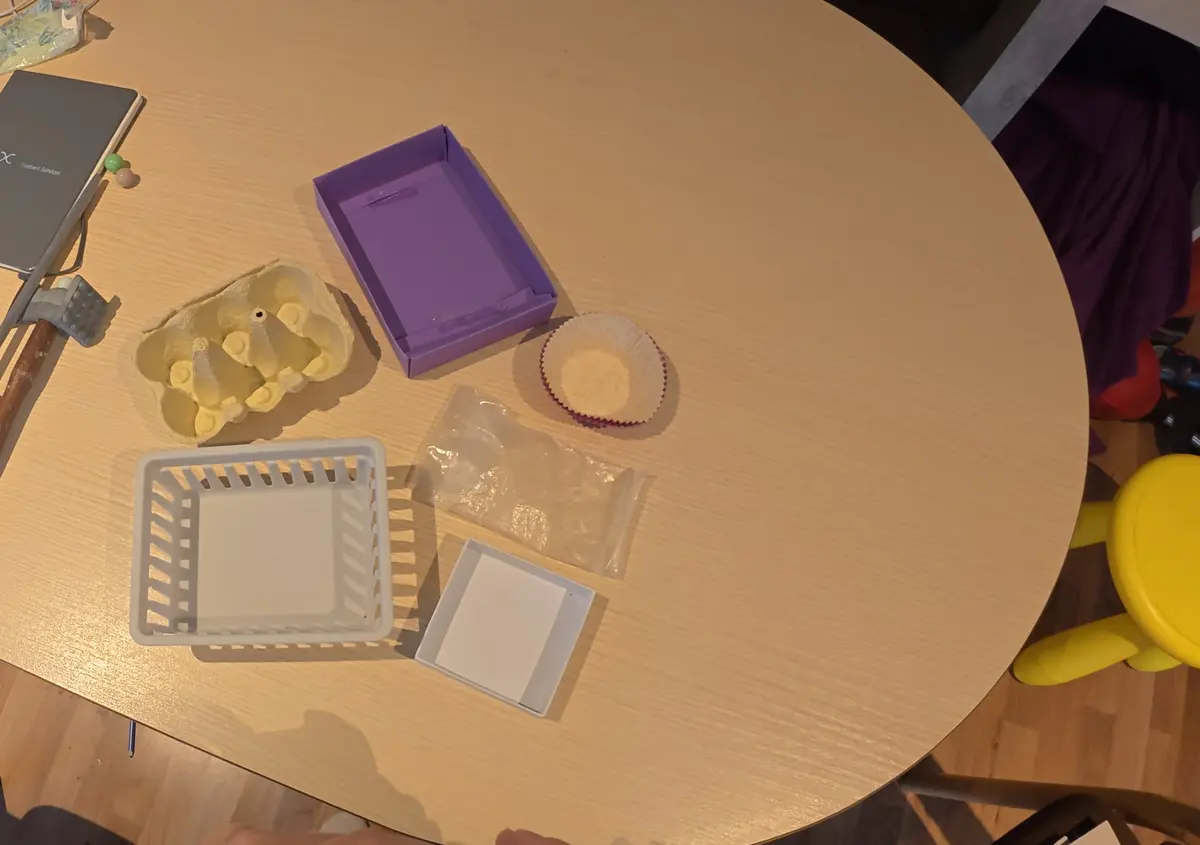
What I asked AI
I didn’t ask ChatGPT to make the drawer beautiful.
I asked it to make the drawer easy to use.
My requirements were simple:
- use what I already had first
- remove things that clearly belonged somewhere else
- keep the number of categories small
- avoid lots of tiny containers
- keep everything visible and easy to grab
- make the system realistic to maintain
In other words: very Butterfly-friendly.
Copy-paste prompt
Here’s a cleaned-up version you can adapt to your own drawer:
I want to organize one messy household drawer without buying anything new.
The drawer currently contains:
[list the main things in your drawer]I already have these containers or boxes at home:
[list what you already own]I want the system to be visible, easy to access, low-maintenance and simple enough to keep using.
Please:
1. tell me what should probably move out of the drawer,
2. group what stays into only a few useful real-life categories,
3. tell me which of my existing containers are actually worth using,
4. avoid over-organizing or creating lots of tiny categories,
5. recommend buying nothing unless the drawer genuinely cannot work with what I already have.Give me the simplest practical setup, not the prettiest one.
That last part turned out to be important.
What ChatGPT actually suggested
The useful advice wasn’t some clever storage hack.
It was basically:
Stop trying to organize every object individually.
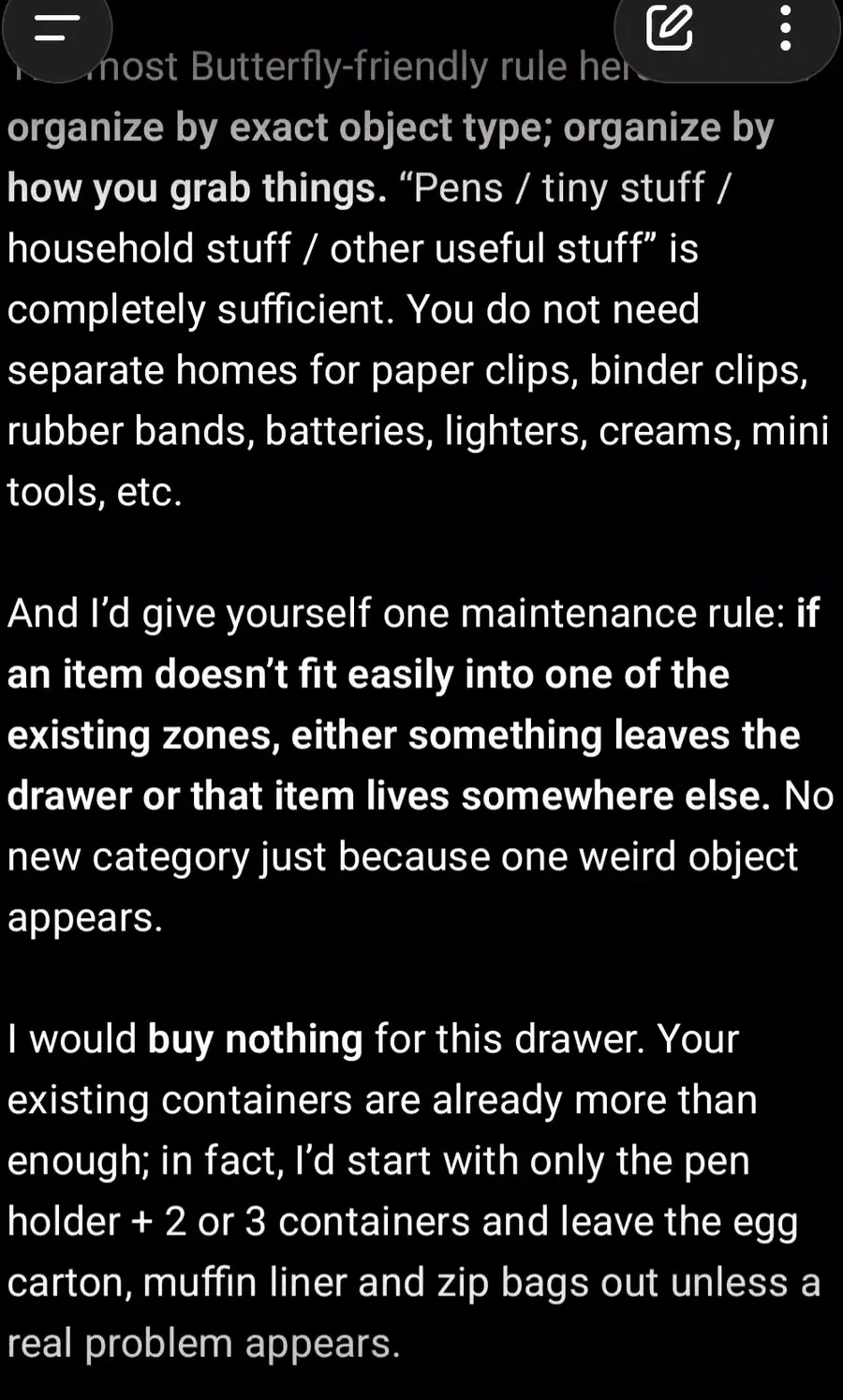
The AI pushed the setup toward a few broad categories instead of lots of tiny ones.
It also suggested removing obvious misfits first, then grouping the remaining things by how they are actually used.
And most importantly: it didn’t tell me to use every container I had collected.
Fewer containers made more sense.
That meant the little egg carton sections, paper muffin liners and some of the smaller options didn’t automatically earn a place in the drawer just because they were free.
Free clutter is still clutter.
What happened in real life
I emptied the drawer, moved out the things that clearly belonged somewhere else and grouped what stayed into a few broad categories.
Then I added only the containers that genuinely made those groups easier to use.
The existing pen holder still worked for longer items.
A larger open basket worked better for a broader utility category than several tiny compartments would have.
A small shallow box helped contain the loose little things that otherwise disappear underneath everything else.
And some items simply stayed visible without a container at all.
That was probably my favourite part of the whole experiment.
Not everything needs a box.
The finished drawer is not especially impressive.
And I mean that as a compliment.
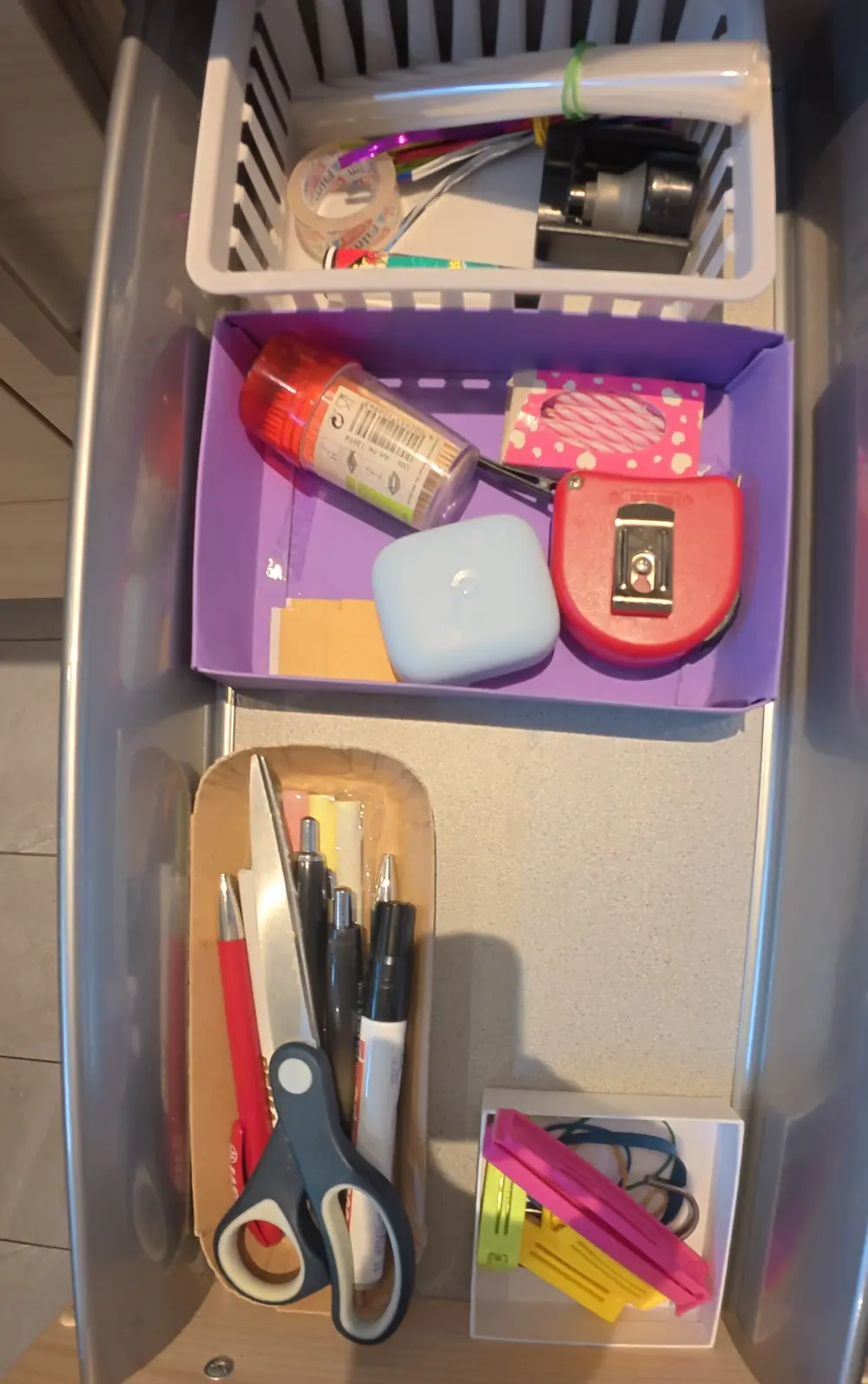
It isn’t perfectly colour-coordinated.
Every object doesn’t have its own little compartment.
Nobody is going to save it to a dream-home inspiration board.
But I can see what is in there.
I can grab what I need.
And putting something back only needs a simple rule for where things belong, not a seventeen-step filing system.
That is much more useful in our house.
The part I’d keep for other organizing projects
The AI itself wasn’t magic.
The helpful part was using it to question my first assumption:
Do I actually need to buy something to solve this?
For a small clutter problem, I’d now use this order:
- Remove what doesn’t belong.
- Group what remains by real-life use.
- Use only the containers that genuinely help.
- Keep things visible and easy to return.
- Buy something only if there is still a real unsolved problem.
That feels a lot more sustainable than automatically starting with a shopping search — and it reminded me of another time I decided that stopping was the better solution.
And considerably easier than turning every messy drawer into a weekend project.
Try it yourself
Pick one annoying drawer, basket or small clutter hotspot.
Not the whole kitchen.
Not the entire house.
Take a quick look at what you already own, give AI the real contents and your actual requirements, and ask for the simplest no-buy setup first.
Worst case: you still decide you genuinely need an organizer.
Best case: the solution was already sitting somewhere in your house.
Before you buy another organizer, what’s one messy drawer or basket you could try this on first?